
Your Real Monthly Number: Budgeting for a Home in the Charleston Area
Before you settle on a price range, it helps to know what owning a home in the Charleston area really costs each month. This guide walks through each expense, from property taxes and flood insurance to HOA dues and upkeep, and shows how we help our buyers build a budget they can trust before they fall for a house.
How Much House Can You Afford in Charleston?
What you can afford in Charleston comes down to your total monthly housing cost, not your mortgage payment alone. Principal and interest is only one piece. Property taxes, homeowners insurance, flood insurance, HOA or regime dues, utilities, and a home maintenance reserve each add to it, and several of them swing sharply by address. Budget the whole number first, then work backward to a purchase price.
Key Takeaways
Budget the total, not the loan. Your mortgage payment is only part of the picture. Taxes, insurance, dues, utilities, and upkeep all belong in your monthly budget.
Your tax classification matters. South Carolina assesses an owner-occupied primary residence at 4% of fair-market value, while a second home or investment property is generally assessed at 6%, before local millage is applied.
Flood insurance belongs in the budget before you write an offer. Most Lowcountry homes are in a flood zone, and the premium can change what a home really costs each month.
HOA dues, insurance, and upkeep are property-specific. Real quotes and real documents beat any area average.
Prices vary widely across the Charleston area. A single regional figure can't tell you what a specific home will cost to own.
What Monthly Costs Decide What You Can Afford in Charleston?
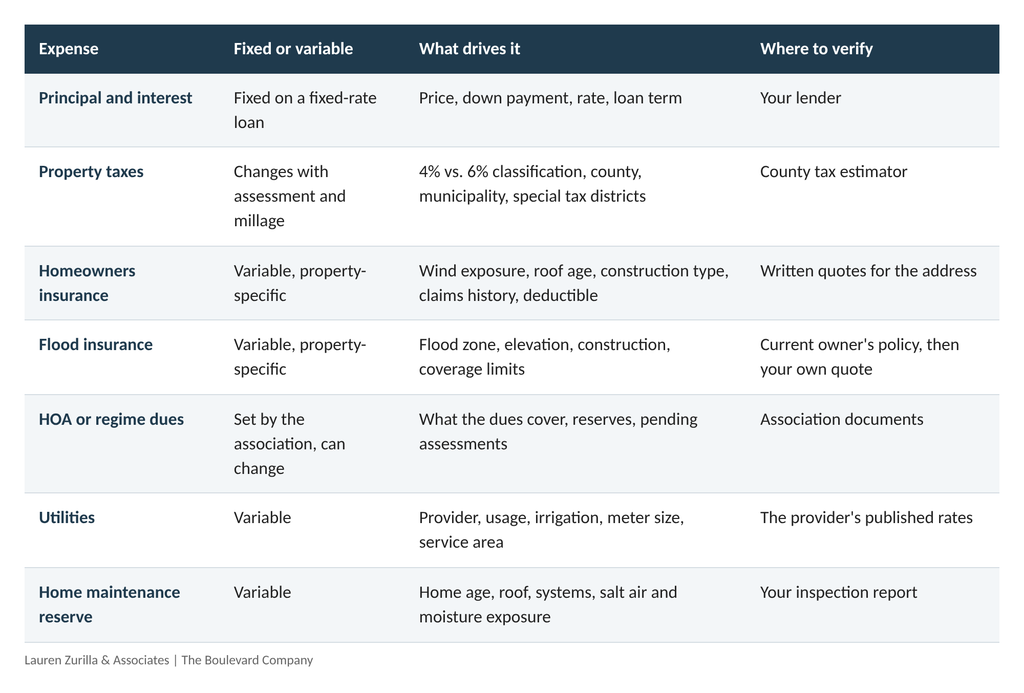
Seven expenses make up your real monthly cost: principal and interest, property taxes, homeowners insurance, flood insurance, HOA or regime dues, utilities, and a home maintenance reserve. Your lender will show you principal and interest first, and it's the easiest to calculate. It's also the expense least likely to tell you whether a specific house fits your life.
Here's the simple formula we use with our buyers:
Total monthly housing cost = principal and interest + property taxes + homeowners insurance + flood insurance + HOA/regime dues + utilities + home maintenance reserve
Looking at each expense on its own matters because they behave differently. Some are fixed, some move with usage or policy changes, and some depend entirely on the property.
How Are Property Taxes Calculated on a Charleston-Area Primary Residence?
In South Carolina, your property tax bill starts with how the home is classified, and local millage rates are then applied to that taxable value. Charleston County identifies the 4% ratio as applying to an owner-occupied primary residence. Confirm the property will qualify for the legal-residence classification, and don't assume a second home or investment property gets the same treatment. Non-primary property is assessed at 6%, a difference that can change the math materially, as the Charleston County Auditor's tax estimator reflects. If you're buying in Berkeley or Dorchester County, use that county's auditor resources instead.
One caution: the prior owner's tax bill is not a reliable forecast of yours. If ownership status or assessed value changes, so can the bill.
How Much Is Homeowners Insurance in Charleston?
There's no honest flat number, because the premium depends on the specific property. Insurers look at wind exposure, roof age, construction type, prior claims, and the deductible structure. Get written quotes for the actual address once you're under contract, so the premium is a known number rather than a surprise after closing.
When Should You Factor in Flood Insurance?
Before you write an offer. Most Lowcountry homes are in a flood zone, and flood coverage is typically a separate policy from your homeowners insurance, which means a separate expense in your budget. When a home you like has a flood policy in place, we share what the current owner pays before you decide whether to make an offer, because that number is part of the decision.
Once you're under contract, get your own flood quote alongside your homeowners quote. Whether your lender requires flood coverage depends on the lender and the property, so ask yours directly. An elevation certificate isn't required, but if the home has one, it may help lower the premium.
Do Charleston-Area Homes Have HOA or Regime Fees?
Many do, but not all. Condominiums, townhomes, planned communities, and some single-family neighborhoods charge recurring dues, and what those dues cover varies a lot. Some include exterior insurance, landscaping, common-area maintenance, amenities, or roofs, and others cover very little.
Before you rely on any monthly estimate, review the current budget, the fee schedule, the reserve information, and any pending assessments. We help our buyers get the complete association documents so nothing important gets missed.
What Utilities Should You Budget For?
Plan for water, sewer, electricity, trash, internet, and gas if the home uses it. Across the Charleston area, water, sewer, and power are served by different providers depending on where the home sits, and even within one provider, rates can differ for properties inside and outside municipal limits.
Look up the actual providers for the address and check their published rates. Minimum service charges are floors, not bills. What you'll actually pay depends on usage, irrigation, and meter size.
How Much Should You Set Aside for Home Maintenance?
Give home maintenance its own place in your monthly budget, and size it to the house rather than to a generic rule. Older homes, large roofs, extensive exterior wood, and properties exposed to salt air or heavy moisture tend to need more frequent and costlier upkeep than newer inland construction. Your inspection report is the best starting point for deciding how much to reserve.
Why Does Your Budget Change from One Charleston-Area Community to the Next?
Purchase prices differ widely across the Charleston area, and the price affects nearly every other expense in your budget. But price isn't the only variable. Mount Pleasant, the city of Charleston, Daniel Island, North Charleston, Summerville, West Ashley, James Island, and Johns Island can differ in tax millage, utility providers, insurance exposure, and HOA prevalence.
So a budget that works in one community won't necessarily carry over to the next. The reliable number comes from the specific home: its price, its tax classification, its insurance quotes, its HOA documents, and its utility providers.
How Do You Build a Monthly Number You Can Trust?
Decide the total monthly amount you're comfortable with first, then let the price follow. Here's the order we recommend:
1. Talk with a lender before you tour. You don't need a pre-approval in hand to look at homes, but you will need one before you make an offer, and an early conversation keeps you from falling for a house outside your comfort zone.
2. Set your all-in monthly ceiling. Start with the monthly total you're comfortable paying, then work backward to a price range.
3. Check the tax classification. Confirm whether the home will be your legal residence (4%) or non-primary property (6%), then run the numbers through the county tax estimator.
4. Ask about flood costs before you offer. Find out what the current owner pays, then get your own flood and homeowners quotes once you're under contract.
5. Read the association documents. Look at what dues cover, the reserves, and any pending assessments.
6. Price your utilities and maintenance. Use the providers' published rates and your inspection report, not a guess.
If you're new to the process, our first-time home buyer guide for Charleston covers the broader steps. For the cash you'll need once you're under contract, see what to budget for when you go under contract. And once you've found a home you like, how to avoid overpaying in the Charleston area will help you test the price against the market.
Frequently Asked Questions
How much income do I need to buy a house in Charleston, SC?
There's no single income figure, because it depends on the full monthly cost of the specific home, your other debts, and your down payment. Prices vary widely across the Charleston area, so the answer changes with the community and the property. A lender can run your numbers, and we can help you match them to real homes.
What is the monthly payment on a $700,000 house in Charleston?
It depends on your rate, down payment, and loan term, and principal and interest is only one piece of the total. Property taxes, homeowners and flood insurance, any HOA or regime dues, utilities, and maintenance all add to it, and those vary by address. We're glad to build you a worksheet for a specific home.
Are property taxes different in Mount Pleasant, Charleston, and Summerville?
Yes, they can be. Taxable value is the assessed value multiplied by local millage, and millage varies by county, municipality, and special tax districts. Use the county tax estimator for the actual parcel rather than assuming one rate across communities.
Do I need flood insurance in Charleston?
Most Lowcountry homes are in a flood zone, so flood coverage should be part of your budget conversation for nearly any home you consider. Whether a lender requires it depends on the lender and the property. We share the current owner's flood policy cost with you before you write an offer so you can factor it in.
How much should I budget for homeowners insurance in Charleston?
Budget from a written quote for the specific home, not an area average. Wind exposure, roof age, construction type, claims history, and deductible all affect the result, and flood coverage is usually a separate policy.
Do Charleston-area homes usually have HOA or regime fees?
It varies by property type and community. Condos, townhomes, planned communities, and some single-family neighborhoods charge dues, while other homes have none. Always review the association's budget, fee schedule, reserves, and any pending assessments before you rely on a monthly estimate.
Bottom Line
The number to plan around is your total monthly cost, not the loan payment alone, and it only becomes reliable once you plug in a specific home. Flood insurance, tax classification, and HOA dues can each move that number more than buyers expect. We walk our buyers through this worksheet before they tour, so the homes we see together are ones that fit the budget.
Ready to Find Your Number?
When you're ready to see what you can afford in Charleston, Mount Pleasant, or the surrounding communities, schedule a Charleston-area buyer consultation with our team. We're always happy to answer questions, whether you're buying this season or just starting to plan.
Warmly,
Lauren, Tina and Gigi | Lauren Zurilla & Associates | Your Charleston Real Estate Experts | The Boulevard Company
Equal Housing Opportunity. Real estate licensees in South Carolina are regulated by the South Carolina Real Estate Commission. This article is general information, not legal, tax, or financial advice. Confirm your own numbers with your closing attorney, tax advisor, or lender.
Check out this article next